
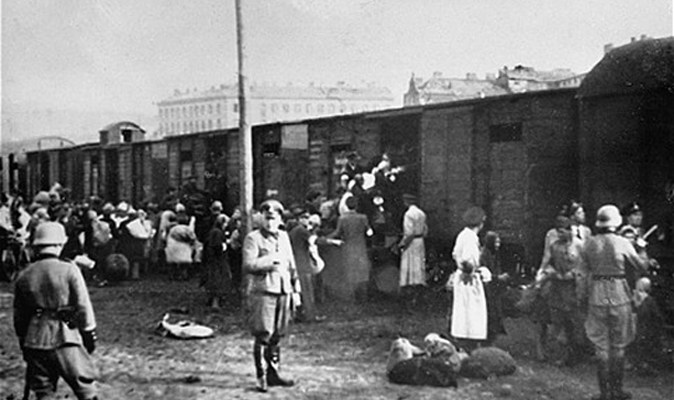
July 22nd, 1942 was the first day of the so-called Grossaktion Warsaw (Grossaktion Warschau, Große Aktion), essentially the active deportation of hundreds of thousands of Jews from the ghetto in occupied Warsaw.
Posters hanging throughout the ghetto portrayed the German initiative of „resettlement in the East” for Jews to work in territories confiscated from Soviet Russia. The first practical step was to force and “lure” people to the Umschlagplatz, the principal railway ramp serving the entire ghetto. Escapes from that initial Umschlagplatz step were only possible through enormous confiscatory bribes. And once bribes were no longer effective, the only method of escaping –– with little if any chance of survival –– was jumping from a moving train. German guards stood ready to shoot those who’d made up their mind, so they either died under the train wheels, were shot on sight, or laid wounded near the tracks until their last breath.
But beyond that first step, did people in the Warsaw ghetto know what actually awaited them?
While a miniscule percentage saw the “Eastern resettlement” as a chance to improve their lives, the vast majority perceived it as a threat and viewed it with apprehension, even dread. Just ten days after deportations began, the Bund party sent its scout, Załmen Frydrych, to check where the trains from the Umschlagplatz were headed. Their envoy learned (mostly from railway workers willing to share) that the railway line would split, with one sidetrack specifically leading to the Treblinka station. Furthermore, trains filled with people would always return empty, and food deliveries never took that sidetrack course. Subsequent meetings with refugees from Treblinka confirmed the worst; assumptions and correlations were categorically true. Treblinka was a “crime scene,” an intentional location where people were herded into mass murder. Yet even when another fugitive, Dawid Nowodworski, returned to Warsaw on August 11th, he was still met with seemingly intentional denial. When he shared about his trip to –– and escape from –– the camp, the response was nearly universal. „Nobody believed that [we were going] to die.”
That December an article with the explicit title, „Warsaw Jews are Murdered in Treblinka,” was published in the underground Bund newsletter. The information was categorically denied not because it wasn’t true, but because no one could believe it. Perhaps no one wanted to believe it. The news created paralyzing fear; the people yearned for a silver-lining of hope.
A particularly insightful image of the death camp was provided by a man who spent several days in Treblinka and went through indescribable circles of hell. Jakub Abram Krzepicki –– a former soldier in the Polish army and a man of great courage and cunning –– shared every detail, every warning, every plea he could. And while his report survived, he himself perished in the Warsaw Ghetto Uprising eight months later. His heart wrenching report was written by Rachel Auerbach, a deft writer from the underground organization operating in the ghetto, „Oneg Shabbat.” But the manuscript wasn’t discovered or revealed until well after the war.
What Happened to the Deported People?
In a larger sense, Grossaktion Warsaw was the penultimate stage of Operation Reinhard, the main goal of which was to eliminate Jews living in occupied Poland. Permanently. The final stage was mass murder. The operation’s first transport departed the evening of July 22nd; the very next day those people were gassed. And worth noting is the fact that that “shipment” was the first use of the newly constructed gas chambers in Treblinka.
The very same day the chairman of the Judenrat committed suicide in the ghetto, unwilling to sign the German deportation ordinances. So the Germans presented their demands to the Jewish police. And under those direct German orders, the policemen began to round up thousands of people at the Umschlagplatz, implicitly hoping that in this way they could at least save themselves and their loved ones. Of course –– and as always –– it was a massive miscalculation. The very last transport from Warsaw to the Treblinka gas chambers on September 21st consisted almost entirely of policemen and their families. That’s how it always worked.
After forced deportation from the Umschlagplatz countless people suffocated due to lack of air on the trains and died of heat exhaustion, exposure, and dehydration. The tragic, dehumanizing journey lasted hours. Immediately upon arriving at Treblinka, Jews had to hand over everything they had, strip naked, run along a 360-yard barbed wire path masked with tree branches, and get herded into rooms pretending to be bathhouses. Women’s hair was shaved. (So Germans could use it to make submarine mattresses.)
In order for as many people as possible to fit in a gas chamber, the victims of German mass murder had to stand with their hands raised above their heads. These innocents were murdered with the exhaust from retrofitted Soviet tank engines. If the engines ran without failure, it took about 20 minutes of indescribable suffering for people to perish. But when engines broke down –– which happened far too often –– they’d finally die after hours of agony. During the initial period of Treblinka’s operation, there were three chambers housing between 500 and 800 people each. Ultimately, the Germans built three more chambers. Just to keep up with the transports.
It only took about two months for the Germans to deport about 265,000 innocent human beings from Warsaw to Treblinka. And an additional 10,000 were murdered just by being herded to the Umschlagplatz. The camp commandant at the time was an Austrian psychiatrist, Irmfried Eberl, and a subordinate recalled his exemplary demeanor and focus: „Dr. Eberl’s ambition was to reach the highest possible numbers and exceed all the other camps. So many transports arrived [so consistently] that the disembarkation and gassing of the people could no longer be handled.” Eberl’s ambitions created chaos. Trains overflowed with victims waiting, even begging, to be unloaded, while up-to-date gas chambers couldn’t keep up with gassing protocols and necessities. People not only died in carriages –– they died being loaded into carriages, exiting carriages, herded into gas chambers, and inside gas chambers. Krzepicki recalled the unfathomable: „We saw a nightmarish sight. There were huge amounts of corpses, one on top of the other. According to my calculations, there were ten thousand corpses there. There was a terrible stench around it. The corpses were swollen, their bellies terribly bloated. Covered with brown or black spots, there were vermin swarming on the corpses.”
Three Goals, Three Primary Purposes
The explicit, intentional, and singular goal of the German authorities, of course, was to annihilate the Jews. According to German plans, the Jews were to be not only murdered, but concurrently robbed of their property. Jewish genocide was meant to be profitable for the German state. The new camp commandant, Franz Stangl, amplified these assertions upon his arrival in Treblinka: „When I entered the camp and got out of the car on the square I stepped knee-deep into money; I didn’t know which way to turn, where to go. I waded in notes, currency, precious stones, jewelry, clothes…”
There are no documents left revealing the extent of the explicit theft and plunder that accentuated the Treblinka genocide. However, official reports ranging from August 22nd to September 21st confirm the export of 243 freight wagons sent back to the Reich filled entirely with the property of the victims. Robbery had always been the logical, conclusive “second target” of mass murder.
And that effectively combined both targets into the third element of mass murder, namely, the means to an effective end. The German organized mass murder efficiently –– so that victims were intentionally included in the mechanism of the crime. That way facilitating streamlined and efficient mass murder could lower overall cost, and a lowered overall cost would facilitate even more efficient genocide. Essentially the entire system operated on the principle of self-sufficient perpetual motion: the mechanism of genocide would be operated by Jewish slaves working in the camps solely hoping for survival. Those slaves would cost nothing; their “supplies” were the successive transports of murdered people’s possessions.
Actively involving Jews in their own genocide began with Jewish administration of the ghettos. After all, they wanted to “keep themselves safe.” It was deepened and cemented by the activities of the Jewish police and those who’d later become the so-called „functionaries” in the camps. They figured that “enforcing German laws might save Jews from German reprisal.” And finally there were the Jewish prisoners at the camps, emptying gas chambers, burning corpses, and scattering ashes. They were those “last victims,” the one’s still thinking they were doing what needed to be done to “survive.”
Intentionally and tactfully blurring the boundaries between the executioner and the victim exemplified German utility and Jewish desperation –– protection against resistance and a justifiable rebellion of those sentenced to death. An escapee from Treblinka reported the familiarity and fait accompli: „There were three Jewish paramedics, about 50 to 60 years old, with Red Cross armbands, whose purpose was unknown. They were seen setting the children over the grave so that they would fall in when shot… More than once, clothes sorting workers –– mostly young –– [would] see their fathers running naked with their clothes on, shouting greetings on the run.”
The German genocide mechanism functioned on lies, deception, physical and mental terror, and the skillfully cynical use of human hope for survival –– by far the strongest and therefore most easily manipulated emotion among the victims. And the calculable, intentional foundation of such approaches and activities was the total dehumanization of Jews.
German thinking became as simple as, “We could never do this to ourselves or other human beings –– to people like you and me –– so that’s why it needed to be done to the Jews.”
Physical, Psychological, and Perpetual Terror
The hope to survive –– to simply live a little longer –– is a powerful force. Dying tomorrow is always better than dying today. So for that “promise” of death a little later –– or at least not now –– death camp prisoners were willing to do anything. So it should come as no surprise that in Treblinka, about 25-30 Germans and roughly a hundred so-called Ukrainians (Soviet prisoners of war) were enough to murder over 800,000 innocent people. That keen observer from the beginning, Krzepicki, noted diligently: „Incredibly how people learned to live not a day or an hour, but literally a minute, and how cleverly they disavowed the thought of impending death. Others seriously counted on the liberation that could come from heaven, from earth, with the approaching end of the war… It was really desperate, as the will to live made people so childish, it was connected with a hope that was worth nothing. Living in these conditions, which the Germans had so cleverly created, meant that most young, healthy people walked as if in a lethargy, unable to take any action, make any decision…”
With that in mind, the Germans intentionally took advantage of fear itself. There were never any rules that guaranteed survival, so obeying orders –– immediately, relentlessly, almost robotically –– was never enough. People who refused to give up hope may have lived longer in some cases, but ironically the longer they survived the more likely they were to be beaten and murdered for this reason or that reason, any reason or no reason. A fugitive from Treblinka recalled that chaotic logic and logical chaos: „When the camp commander came to the square (by bike), he chose one or two who he did not like, told them to undress, led them to the burning grave, and shot them. A similar procedure took place twice a day, after breakfast and dinner. If any of them wanted to ask for something before being shot, the commander would hit him in the face with his whip and then shoot the other one while he spoke.”
At any given moment it could be a gesture, an unexpected breath, or an unintentional facial expression –– anything that caught a guard’s momentary attention –– and a prisoner would be shot. The overwhelming toxicity of relentless fear and illusory hope robbed prisoners of any thought of resistance. „A kilometer from the camp there was a suspicious stench of rotting bodies, of burning meat. The voices of women and children, like the screams of birds or the squealing of pigs in a slaughterhouse, even reached the ears of workers in the forest. We often thought that we were hearing that deep, male bellow, as if the roaring of the oxen in the slaughterhouse. Was it not because the gas chamber door was opened a minute too soon? In the great confusion, in the great race, we were not forgotten either. The Germans know how to organize the job perfectly. Everyone at their post is doing their job. Workers are not allowed too much a break from danger and fear. Not a day went by without a bullet being loaded into a few boys’ necks. Not a day went by without the specter of selection before everyone’s eyes. If not today, then tomorrow –– it will be your turn.”
Krzepicki wasn’t being literary in that description. It was literal. It simply described what happened. It described the reality of mass murder, the full spectrum of individual terror to industrial genocide.
Nothing But Lies
The Holocaust was always a lie. That was its essence, its most important detail, its foundation. And the foundational lie? The original deceit? The well-established stereotype of Germans as a „high culture” and „higher civilization.” And the Jews especially believed that stereotype, that legacy, that image. Because they had to. It was a stereotype so powerful and so all-encompassing that it allowed the Germans to lie on a scale never seen in human history.
So it all began with the lie of what the ghetto was. The ghetto gave the illusion of security, the illusion of autonomy, the illusion of war survival. And then only too quickly, when a population starving and decimated by diseases in those ghettos was granted the promise of improved living conditions, they were convinced that all it’d take was a planned „resettlement to the East.” Another German lie, another sensible explanation, and another promise to the Jews.
Marek Edelman, one of the leaders of the ghetto uprising, recalled the lie’s routine mundacity: „Finally, the Germans announced that everyone who reported to work would receive three kilograms of bread and marmalade. They handed out ruddy loaves, and people took the bread and obediently entered the carriages. There were so many people that two transports departed to Treblinka every day.” Every single person who managed to escape from Treblinka claimed without hesitation that lying was the precise, intentional foundation at all stages of the journey to the gas chambers.
Detailed examples abound. Every train that arrived with its thousands of victims was accompanied by an orchestra playing familiar pieces to subconsciously convince the Jews that they’d reached a safe, civilized place. They were told upon arrival that their shoes would be returned, so the guards ordered they be tied with laces to prevent getting lost when their owners picked them up after leaving the „bathhouse.” But no one ever left the bathhouse –– at least not alive. Informative signs and bulletins throughout the train station were meant to give the impression of an intermediate stage –– between the necessary “bathhouse” and the ultimate “resettlement to the East.” An escapee from the camp, Jakub Rabinowicz, shared the detailed lulls, „On the side of the square, on a tall pillar, there is a sign with a huge inscription: ‘Achtung Warschauer! You have been relocated to start working. Before receiving an assignment, you must have a bath. Everyone must strip naked. Valuables and money should be left, documents and soap must be taken with you.’”
Innocents too weak to reach the gas chambers after the train journey were simply shot by functionaries wearing armbands with a red cross, while SS guards who officiated the train’s arrival wore white coats to give the impression of being a doctor. The Germans even built a fake train station edifice with a dummy clock next to the railway ramp. Jakub Krzepicki explained, „A little later an SS man approached us and gave a speech. He spoke calmly, and at times even with humor: ‘Don’t be afraid,’ he repeated every now and then. ‘Nothing will happen to you. These corpses here in the barrack,’ the German charmed us, ‘they were brought to us. These people choked up in the carriages due to the lack of air. We are not responsible for it. Everyone will be treated well. Everyone will get employment in their own profession: tailors in tailoring workshops, carpenters in carpentry workshops, shoemakers as shoemakers.’ Work and bread. Some began to state their professions. Emboldened they came closer, and the German laughed broadly and kindly, checked their muscles, patted their backs: ‘Yes, yes, good, you are strong, you are fit!’ There was applause.”
Another escapee from the camp recalled the detailed focus on –– and manipulation of –– hope itself: „To illustrate the perfidy and the German cheating system, one more fact that took place in Treblinka in the second half of August. (…) One night an air attack was announced, and therefore the searchlights were turned off. The commander feared that the darkness of the night would be exploited by the Jews and that they would try to flee the place of execution. In order to prevent this, the boss ordered all the Jews to be gathered in the square before the lights were turned off, and he made a speech in front of them, in which he most seriously announced that the agreement between Hitler and Roosevelt on sending Polish Jews to Madagascar was concluded and that the first transports from Treblinka will be dispatched tomorrow morning.” Another escapee quoted the words, the specific terminology, of an SS man: “This is not a boarding house, but a labor camp. As an SS man, I guarantee you that you will be fine, that you will eat well and sleep well. I used to go to school with Jews, played football, and had Jewish friends.”
The lie continued each and every day until the very last moments of life. The SS man driving the women to the gas chamber yelled emphatically, almost encouragingly, „Dear ladies, quickly, quickly, quickly! The water is getting cold!” But there was no water. The only thing running from those ceiling showers was gas. Yet to activate the gas trigger itself, commanders yelled, “Wasser!” Lies to the very end. Detailed lies to the very moment of death.
But even innocent lives ending didn’t guarantee the end of those lies. The final installment of this unprecedented fraud –– the last element of the humanitarian crime itself –– was the way these genocide perpetrators were treated by German and Austrian authorities after the war. While claiming to hold the guilty accountable, every turn or trick was committed to avoid bringing the guilty to trial, or at least to make it as delayed and insignificant as possible. The head of Operation Reinhard, Hermann Höfle, was handed over to the Austrian judiciary in 1947, yet was “inadvertently” released. When Poland asked for his extradition, he was hiding in Italy, then Germany. Ultimately, he was arrested in Austria in 1961, but managed to commit suicide before the trial began.
The commander of Treblinka, Franz Stangl, spent many years in Brazil under his very own name and worked at the Volkswagen plant in São Paulo. A certified arrest warrant for Stangl was finally issued by Austrian authorities in 1961, and he was arrested only in 1967, largely thanks to the efforts of Simon Wiesenthal. He was sentenced in 1970, and died less than a year later in 1971. The third camp commandant, Kurt Franz, who had personally murdered hundreds of prisoners, wasn’t convicted until 1965. And he didn’t serve his full sentence. He was released from prison early in order to spend the rest of his life –– until the age of eighty-four –– in a comfortable retirement home.
Franz Suchomel, a commander personally responsible for hauling victims from the trains to the gas chambers after explaining the confiscation of their luggage –– the same one who encouraged Jewish women to enter the gas chamber quickly because „the water was getting cold” –– was sentenced to six years prison, but released after four.
“Lies to the very end.” The lies were maintained until the last minutes of countless innocent lives. But the premise of these lies far outlasted mass murder, genocide, the Holocaust, or even World War II.
In a sense, the lies developed a life of their own, so much so that even those guilty of the lies –– those guilty of lying –– continued the tradition and the protocol far beyond the purposes claimed by leaders and nations at war.
The lie that protected, preserved, streamlined, and executed the murder of millions of innocent human beings lasted much longer in Germany and Austria –– amid Germans and Austrians –– than the Third Reich and Nazism ever could.
This is what happens when the idea of an “end” is the greatest lie of all…
Paweł Jędrzejewski
(Photo: Jews loading onto trains at the Umschlagplatz in Warsaw during the German occupation of Poland)
 Forum Żydów Polskich