
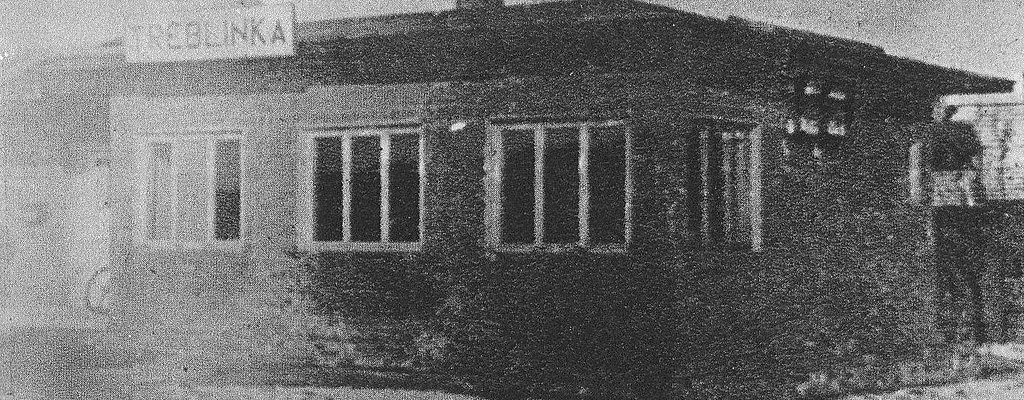
On August 2nd, 1943 an uprising broke out in the Treblinka death camp. The prisoners attacked guards, set camp buildings on fire, some even managed to escape. And several dozen of those escapees survived the war thanks to that uprising.
More than a year earlier, when the Germans commenced the genocide operation under the code name „Reinhardt,” the purpose of which was to murder all Jews living in territories belonging to Poland before the outbreak of war, they realized that the death camps in Bełżec and Sobibór that had been operating since the spring of 1942 were insufficient. Quite simply, they lacked the necessary “processing capacity.”
So the Germans set three specific goals for their efforts. First and foremost, their single most important purpose was to murder as many Jewish men, women, and children as possible in the shortest amount of time. The second goal was to rob them and transport all stolen items to the Reich. And the third was the necessary obliteration of all traces of genocide. (Although that specific necessity only appeared later, when the criminals faced the threat of revealing their unprecedented crimes to the Red Army approaching from the east.)
In March 1942 the extermination camp in Bełżec began operation, and two months later, the murder of innocents in Sobibór commenced. On April 17th, 1942, SS Chief Heinrich Himmler arrived in Warsaw and handed over the decision to liquidate the Warsaw Ghetto to local German authorities. There were over 400,000 prisoners in this ghetto alone, so it became quite clear that the existing extermination camps were no longer enough.
So that’s when construction of Treblinka officially began. And on July 23rd, 1942, the first transport of prisoners from the Warsaw Ghetto arrived at Treblinka. After the war, Polish railwayman Franciszek Ząbecki described this moment:
„The train consisted of 60 covered cars, crowded with people. There were old, young, men, women, children, and babies in blankets. The doors of the cars were locked, the windows barred with barbed wire. On the steps of the cars on both sides of the train, and even on the roofs, several SS men stood and lay with machine guns ready to fire. (…) The ‘resettlers’ were incredibly crowded in the wagons. Everyone had to stand, deprived of air access and the possibility of taking care of natural needs. They were like hot ovens. High temperature, lack of air, heat created unbearable conditions, even for healthy, young and strong organisms. Moans, screams, cries for water, for a doctor came from the wagons. (…) The whole station was filled with groans and screams of several thousand people.„
These people were immediately exterminated in the gas chambers. From that day onward, one train –– loaded with thousands of human beings –– arrived every day, and from August 6th, the standard transport was raised to two trains. There were about 5,000 innocent people on each and every transport. The „ambitious” commandant of the camp, the Austrian doctor Irmfried Eberl, wanted to maintain a good impression on his superiors, so he demanded constant increases in the number of people destined for death. Soon enough, those demands only necessitated building new, larger, and more streamlined gas chambers.
The death camp staff consisted of around forty Germans and Austrians –– SS soldiers or policemen –– and about 100 mandatory guards, recruited from Soviet prisoners of war collaborating with the Germans.
The continuous stream of people “flowing” through gas chambers for months without protest or resistance was based on two distinct German “methods” for extermination camps. One was the simple lie; literally “cheating” and “misleading” those being brought to their deaths. Until their very last steps, prisoners were given the illusion that they’d somehow survive. And relatedly, any “resistance” at a camp meant instant death, because the other side of the lie was the second method, the direct and undeniable one: the indiscriminate use of terror and violence.
The road from the railway platform to the gas chamber was flooded by screams, beatings, and hysteria. So amid those conditions, the third factor that unfortunately precluded rebellion –– the unknowable “wild card” reaction –– was naturally „installed” in people sent to gas chambers.
It was hope. The hope for survival, the hope that inevitably dies last.
Quite simply, those condemned to death more often than not embraced a natural psychological mechanism that kept them believing that they could survive. That they would survive.
Amid those conditions and circumstances, who could incite a revolt? How would they incite an uprising? What realistic conditions would have to be met for any rebellion to even seem possible?
Clearly any “revolt” could never be initiated by people brought to their deaths in wagons. To this day, we continue to have difficulties actually understanding how exhausted by the inhuman traveling conditions, malnourishment, blinding thirst, and relentless sickness these human beings were. They rode degraded cattle cars; they were scared, confused, helpless, never knowing what awaited them.
Understandably, most prisoners actually believed the German promises that they were being transported to labor camps “in the east,” where they’d be provided better living conditions than in the Warsaw Ghetto. Those people –– the overwhelming majority –– were neither capable of any rebellion, nor mentally and physically prepared for it. After all, the very mechanisms of operation for both the ghetto and the death camp was to deprive people of any will to resist. The slightest protest, any tardiness, an accidental refusal to immediately comply with German orders was punishable by instant death on the platform or on the way to the gas chambers. (Still presented as bathhouses until the last minute.) That’s exactly why cases of insubordination among prisoners were rare, sporadic, and ineffectual at best.
However, there was a specific category of prisoners distinct from those sentenced to immediate extermination –– the so-called „Arbeitsjuden.” (“Jews for work.”) The Germans utilized Jews to the very last gasp, especially as free labor in the mechanics and logistics of genocide. So the least emaciated men were immediately delegated to camp labor as they exited the transport trains, never to see their family or friends again.
The functioning of death camps itself was always based on the direct assertion that all physical work needed to be performed by active prisoners. They were the ones who emptied carriages, collected clothes and luggage from visitors, cut women’s hair, sorted looted items, possessions, and valuables. They also did all the “road work” needed to run the camp (i.e. maintenance, renovation, and expansion). They were prisoners of the so-called „lower camp” and their number ranged from about 700 up to 1,500 prisoners. Another group of about 300 Arbeitsjuden were employed in the so-called „upper camp.” They emptied gas chambers, collected the gold teeth of the dead, buried bodies in mass graves, and ultimately burned them on metal grates.
All these prisoners were treated by the German camp authorities with utmost brutality, cruelty, and dehumanization. Germans generally murdered under any and every possible pretext –– or more often for no reason at all –– only to deprive them of any will to resist. The only reaction to resistance was perpetual terror. Such ruthless treatment of Arbeitsjuden resulted in frequent replacement. New prisoners from daily transports were always available to take someone’s place.
However, chronic execution seriously deteriorated the „efficiency” of work. Therefore, the new commandant, who took over in September 1942, ordered the creation of permanent working commandos. At the same time, the number of random Arbeitsjuden executions was reduced, and their living conditions improved. (Barely.) Ironically, under the new conditions designed for the efficiency of German killing, the prisoners were actually given the implicit opportunity to get to know each other, to make friends or comrades, to begin discussions and planning that facilitated the conspiracy and the uprising. Because above all, these prisoners now possessed full knowledge of the camp –– its functioning, its layout and logistics, and therefore its seeming weaknesses.
In other words, the prisoners were unintentionally given the very circumstances necessary to consider their fate, to deliberate their chances of survival. They all knew they were still needed “now,” but especially knowing firsthand the German war crimes in Treblinka, they also knew only too well that they “endangered” the Germans. They knew they’d soon “need” to die.
Their fate was always sealed, but soon enough the daily transports of Jews being brought to their immediate death would no longer arrive, or the war front would get dangerously close, and they’d be murdered before they could be “saved.” It was then that initial information about the German army losses and defeats on the Eastern Front reached them. The liquidation of the death camp became more likely with each passing day. At the same time, the Germans tightened controls in the camp, which made it almost impossible for individual escapes.
Under these unique and unprecedented circumstances, the idea of an organized rebellion and collective escape was born among the Arbeitsjuden. And when they finally received information about the outbreak of the Warsaw Ghetto Uprising, the argument for taking action had essentially already been made.
Specific plans were always discussed in late-night conversations. In early 1943, the „organizing committee” of the uprising was established in the „lower camp” under the command and initiative of Dr. Julian Chorążycki, who unfortunately never lived to see the revolt’s outbreak. The uprising was initially scheduled for June 15th, the explicit aims being to set buildings on fire, destroy the gas chambers, and kill camp personnel. Only by accomplishing those specific tasks would the prisoners manage to escape and perhaps survive in hiding until the arrival of the Russians.
However, when the prisoners tried to establish contact with the local population to buy weapons through commandos working in the forest, the plan failed. They decided that the weapons had to be obtained inside the camp, so while repairing the armory doors, prisoners employed as locksmiths obtained a key pattern and made copies of it. While they managed to obtain a crate of hand grenades, it turned out the fuses were stored separately, just like the actual igniters necessary for the grenades to work. Every step of preparations was always made more difficult by the realities of a camp designed for extermination.
Nonetheless, the revolt finally broke out on August 2nd, 1943 with about 750 prisoners taking part.
Years later, in his book “Rebellion in Treblinka,” Samuel Willenberg recalled that very moment. „The memorable day of August 2, 1943 finally came. It was hot and sunny. The entire Treblinka camp smelled of burnt, decaying bodies of those who had been gassed before. This day was a special day for us. We hoped that what we had long dreamed of would come true. We didn’t think we’d stay alive. All we were preoccupied with was the thought of destroying the death factory we were in.”
Samuel Rajzman, the primary organizer and participant of the revolt, recalls moments just before the outbreak: „The last adjustments in the composition of the teams, the last glances towards the graves, burning bodies, residential barracks and the march to work! It is strange that for the first time after a 12-month stay in Treblinka colleagues feel not as convicts who can die at any moment, but as people who decide their own fate and go to work knowing that only counted hours separate them from the moment of retaliation. (…) The mood in the groups is very hectic and excited, but without the slightest fear of imminent death. (…) In view of the excited mood in the camp, our executioners evidently realized that something unusual was going on, and Hauptscharführer Küttner especially sniffed out the situation and found this mood suspicious. He also ran like a mad dog around the camp to sniff out what was going on.„
„Pictures of miserable life in the camp flash through our minds and it is clear that none of our colleagues will chicken out and will perform their task with full awareness and responsibility. Our group does not care that executioners with machine guns are standing on all observation towers and that we are surrounded on all sides by Ukrainians and Germans. The only desire of all is the desire to take revenge, to pay for our brothers and sisters.„
Szymon Goldberg recalled, “It was supposed to start at 4 o’clock, but it started at 2 o’clock, and instead of a whistle, there was a shot, because one ‘Kuba’ from Warsaw. (…) betrayed. He was killed together with gendarme ‘Kiwe’ (i.e. Hauptscharführer Küttner) just when he was telling him.”
And many years later, Samuel Rajzman finally recounted, „We hear the long-awaited shot at the main gate of our barracks. This is followed by powerful detonations of exploding grenades, and in the same second, the men of my group, who were in possession of the weapons, immediately occupy their posts. The first shot is fired from the rifle of Comrade Monk from Warsaw, who is aiming at the Ukrainian Zugwachman, laying him dead on the spot. The Ukrainians were surprised by the events, the more that our whole group rushed with the main ‘hurray’ at the torturers. The grenades immediately detonated and the entire area of the northern camp immediately stood in one cauldron of smoke and flames. I carefully observed that at the same time fires started in all parts of the camp and a heavy curtain of smoke covered the whole camp. It looked as if providence had finally taken a stand for our wrong and for millions of innocently murdered women and children.„
All in all, the entire Treblinka revolt lasted about 20 to 30 minutes. The insurgents attacked the guards, but it’ll never be known just how many were actually killed. The prisoners set camp buildings on fire, but unfortunately they failed to destroy the gas chambers. Within minutes, Germans and Ukrainians began to fire on the rebels, and the prisoners who avoided being shot ran out of the camp only to have the Germans chase after them.
Of the roughly 850 prisoners at Treblinka at that time, almost 400 died during the revolt and uprising, including the engineer Marceli Galewski, who’d become leader after Dr. Chorażycki died. Another 400 or so ultimately escaped from the camp, and about a hundred of them managed to confuse their pursuers. All in all, about 70 human beings survived the war. And thanks to them, the world learned about the intentional genocide committed by the German state in Treblinka.
Yet even after the revolt was suppressed, the Germans sent several more transports to Treblinka and gassed over 7,000 Jews from the Białystok ghetto. The total number of innocent human beings murdered by the German state in Treblinka was over 800,000. And in November, the camp was finally liquidated, mainly because Operation Reinhardt –– the plan to murder all Polish Jews –– was fully completed.
In the autumn of 1943, the Germans dismantled all the buildings, including the gas chambers, and plowed the area of the camp and sowed it with lupins to cover the traces of their war crimes. But they didn’t succeed.
Hiding the traces of genocide can only do so much… even eighty years later. Because the last of the participants in the uprising, Samuel Willenberg, who passed away in 2016, spent the rest of his life –– every last God-given breath –– telling his story, expressing his struggles, and sharing his eyewitness testimonial describing the German genocide he’d lived through.
If nothing else, today’s article is Samuel Willenberg’s lit torch being passed so that this story never goes dark.
Paweł Jędrzejewski
 Forum Żydów Polskich