

During the Nazi occupation of Łódź, Poland –– renamed Litzmannstadt by the invaders –– the Germans established the second largest Jewish ghetto.
And eighty two years ago, the so-called „Wielka Szpera” („Sperre”) began in Litzmannstadt, the name derived from the German „Allgemeine Gehsperre” meaning a „general curfew.” These two words –– printed in large font on plaques and posters –– littered most of the prominent walls throughout the ghetto. The Germans issued an absolute ban on leaving apartments, which technically began on September 5th, 1942 from 5pm until further notice.
Essentially, this order for families to remain in their own apartments was designed for a singular purpose: for Nazis to forcibly remove the sick, the elderly, and the children permanently. And given the fact that the ghetto administration possessed updated lists of all residents –– specifically with age demographics –– all human beings over 65 and under 10 were to be removed.
It was obvious they’d never be seen again.
The decision to eliminate the sick, the elderly, and the children from the Łódź ghetto was certified by the Reich Security Main Office (Reichssicherheitshauptamt – RSHA) at the end of August 1942. And as a result of this particular action, it’d become a model of factory labor for the German state –– flawlessly efficient and economically effective, utlizing only Jewish slave workers, exclusively those capable of hard physical labor.
To those ends, the three tiers of Jewish victims –– unable to produce, utterly useless, a weight on the war effort itself –– were nothing but an unnecessary cost for the Nazi regime. That is why the Germans made their decision; it perfectly accommodated their anti-human logic. So the “unnecessary” had to be murdered in cold blood. And in order to “eliminate” children, for example, they’d first have to be “confiscated” from their parents.
In the ghetto there was the Radogoszcz (Radegast) railway station, from which people were loaded into freight wagons and transported toward Konin. The final destination was the village of Chełmno on the Ner River (Kulmhof am Ner), approximately 32 miles from Łódź. Beginning in 1941, Jews were murdered in Chełmno with exhaust gas in hermetically sealed trucks. The total number of victims killed in this death camp is estimated at around 180,000. Although transports of Jews from the ghetto to the death camp in Kulmhof had been taking place earlier in the war, ghetto residents still deluded themselves, believing the purpose of deportations meant “relocation” to forced labor camps.
But after 1941, German death camp policy became absolutely clear because while German authorities never officially stated that the sick, the elderly, or the children were by definition sentenced to immediate death, almost everyone figured as much –– whether they’d admit it or not –– because of their morbid rationality based entirely on German treatment of the Jews.
In other words, what else would Germans do with Jews unable to work?
On September 1st and 2nd, 1942, hospitals in the ghetto were permanently evacuated. The Germans collected almost 2,000 patients, including about four hundred children. And despite a few of the sick trying to run away, the Germans murdered all of them right then and there. Needless to say, panic overtook the ghetto.
News spread verbally among inhabitants that in the following days the elderly and the children would be displaced, collected, and relocated. A desperate mass forgery of documents –– a last-minute „attack” by immense crowds on the registration office –– essentially began the same day. The purpose was quite simple and the attempts literally life and death: to officially prove that the elderly were younger and the children were older than their ghetto registry information indicated.
At 4pm on September 4th, Chaim Rumkowski, the head of the Jewish Council of Elders who ruled the ghetto with an iron fist, delivered a speech to a crowd of around 15,000 people. It was beyond shocking. The cruelest and most terrifying fears were confirmed.
Quite simply, Rumkowski informed the Łódź ghetto inhabitants to give up their children and their parents. While some say he “appealed,” others claim he “convinced” or even just “begged.” Regardless, his speech made it crystal clear they were going to die. But he assured them that if this German demand was met, at least the ghetto could be saved.
That was the promise the Germans made to Rumkowski. Of course, the future showed they never had any intention of keeping it. Their goal was –– and would always be –– to murder every last Jew they imprisoned in the ghetto.
But it takes time. So for now they only needed to kill those who could no longer be practically utilized.
German barbarity wasn’t just their explicit willingness to murder innocent human beings solely for being Jews. The German dehumanization of the Jews was so profound, explicit, and all-encompassing, that their total control over the lives of the people imprisoned in the ghetto meant they didn’t even have to “try” to create “hope” for them anymore. They didn’t claim their children and elderly parents were being evacuated from Łódź in order to survive. Nothing like that needed to be done anymore.
And why would it be? To ease the suffering of Jews with “hope?” Never.
Chaim Rumkowski’s speech to the gathered ghetto crowd has fittingly gone down in history as one of the most tragic “expressions” mankind has uttered. His words speak for themselves:
„A grievous blow has struck the ghetto. They are asking us to give up the best we possess –– the children and the elderly. I was unworthy of having a child of my own, so I gave the best years of my life to children. I’ve lived and breathed with children, I never imagined I would be forced to deliver this sacrifice to the altar with my own hands. In my old age, I must stretch out my hands and beg: Brothers and sisters! Hand them over to me! Fathers and mothers: Give me your children!”
His logic, his plea:
“Yesterday afternoon, they gave me the order to send more than 20,000 Jews out of the ghetto, and if not –– “We will do it!” So the question became, ‘Should we take it upon ourselves, do it ourselves, or leave it to others to do?”. Well, we –– that is, I and my closest associates –– thought first not about “How many will perish?” but “How many is it possible to save?” And we reached the conclusion that, however hard it would be for us, we should take the implementation of this order into our own hands.”
His reprehensible responsibility:
“I must perform this difficult and bloody operation – I must cut off limbs in order to save the body itself. I must take children because, if not, others may be taken as well –– God forbid.
I have no thought of consoling you today. Nor do I wish to calm you. I must lay bare your full anguish and pain. I come to you like a bandit, to take from you what you treasure most in your hearts! I have tried, using every possible means, to get the order revoked. I tried – when that proved to be impossible – to soften the order. Just yesterday, I ordered a list of children aged 9 – I wanted at least to save this one aged-group: the nine to 10 year olds. But I was not granted this concession. On only one point did I succeed: in saving the 10 year olds and up. Let this be a consolation to our profound grief.”
His tragic empathy:
“I understand you, mothers; I see your tears, alright. I also feel what you feel in your hearts, you fathers who will have to go to work in the morning after your children have been taken from you, when just yesterday you were playing with your dear little ones. All this I know and feel. Since 4 o’clock yesterday, when I first found out about the order, I have been utterly broken. I share your pain. I suffer because of your anguish, and I don’t know how I’ll survive this –– where I’ll find the strength to do so.”
His despair and depreciation:
“I can barely speak. I am exhausted; I only want to tell you what I am asking of you: Help me carry out this action! I am trembling. I am afraid that others, God forbid, will do it themselves.
A broken Jew stands before you. Do not envy me. This is the most difficult of all orders I have ever had to carry out at any time. I reach out to you with my broken, trembling hands and beg: Give into my hands the victims! So that we can avoid having further victims, and a population of 100,000 Jews can be preserved! So, they promised me: If we deliver our victims by ourselves, there will be peace!!!”

Rumkowski shook and wept. His speech made a cataclysmic impression on everyone. Evening came and the nightmare of September 4th into the 5th began. That night, Józef Zelkowicz, the chronicler of the ghetto, wrote in his diary, „Terrible scenes were played out in the streets of the ghetto, full of spasms and sobs.”
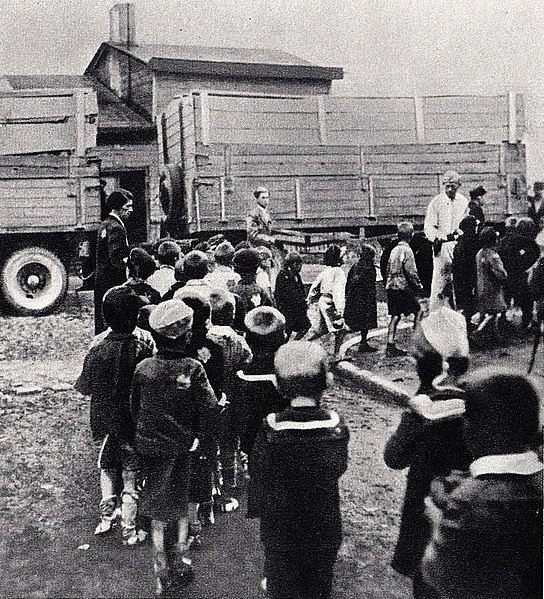
In a brazen attempt to save their own families at the cost of others, the Jewish police voluntarily took part in the action with clubs and sticks, and they were helped by firefighters and the so-called „White Guard,” or Jewish porters. And due to their image as traitors, every last one of them met resistance from parents. The Dante-esque scenes of nabbing children from mothers and fathers who snatched children right back from armed policemen played out through the night. „The screams, fighting, and crying of the mothers and the whole assisting street were indescribable. The parents of the children being taken were formally crazy.” So claimed the eighteen-year-old Dawid Sierakower in his diary.
The nightmare action lasted all night well into the next day, then stalled, the seeming “results” well below German expectations…
So when Germans entered the ghetto –– the Polizei and Gestapo units –– they immediately began shooting anyone and everyone protesting. No restraint, no combat. According to analyses of ghetto administration records, roughly 200 parents were shot on site. And what followed was the phenomenon called, „paralysis of the mothers.” The protests ended permanently. The only response left was indescribable, paralyzing fear.
All inhabitants were lined up in the courtyard in two rows. Germans no longer checked documents. They separated the old and the young –– the elderly in this line and the children in that line –– based exclusively on a momentary visual age assessment. Birth certificates, labor identifications, official “papers?” Meaningless. These innocents were destined to die because of a random and momentary, yet calculated, Nazi decision.
While Germans executed policy, the Jewish policemen checked apartments and specifically searched “hiding places.” Anyone found who’d been assigned deportation or anyone placed in the courtyard lines attempting to “meld” with inhabitants was immediately shot.
„Wielka Szpera” lasted for another week until September 12th, its only “commemoration” were two ghetto announcements hung on walls: the curfew was canceled and workshops would restart on September 14th. Final official data indicated 15,681 people were deported to the death camp and murdered, several hundred were shot on site for disobeying orders, and thirty-five prisoners were hanged for attempted transport escapes.
All the children and the elderly –– with the exception of a handful who were in the families of privileged ghetto administration officials –– were gassed.
One of the fugitives from the death camp in Kulmhof was a man named Szlama Ber Winer (Yakov Grojnowski). His work at the camp had been burying dead bodies, and just a few months prior, he described final moments of victims as follows:
„The gas car usually stopped about one hundred meters in front of the mass grave, but two separate times it stopped about twenty meters away from it –– this past Thursday and last Wednesday –– because it was a transport with Jews. As the ‘pit people’ (i.e. prisoners laying the bodies in the pits) told us, there’s a special buttoned apparatus in the chauffeur’s cabin, connected by two pipes to the car’s interior. The drivers –– there’s always the same two in the gas cars –– pressed the buttons, got out of the cabin, and locked it behind them. Shortly thereafter, there were screams, desperate sobs, and pounding on the walls. It took about 15 minutes, after which the driver returned to the cabin, where he’d shine an electric flashlight through the windshield to see if everyone was dead, and would drive the car about six meters from the grave.”
As protocols demanded –– and as such a description indicates undeniably –– the Germans achieved their goals. Only the Jews who were able to perform essential work remained in the ghetto, and all they cost the German state were a few hundred calories a day.
On August 9th, 1944, when the Soviet army approached, the Germans began transporting 70,000 inhabitants of the Łódź ghetto to Auschwitz-Birkenau, the vast majority murdered immediately.
And efficiently. As always. In fact, with the war spinning out of control, more efficiently than ever.
When the last transport departed for Auschwitz on August 29th, 1944, the Łódź ghetto ceased to exist…
… The last gasps of the Holocaust chiselling themselves permanently into human history.
Paweł Jędrzejewski
 Forum Żydów Polskich