
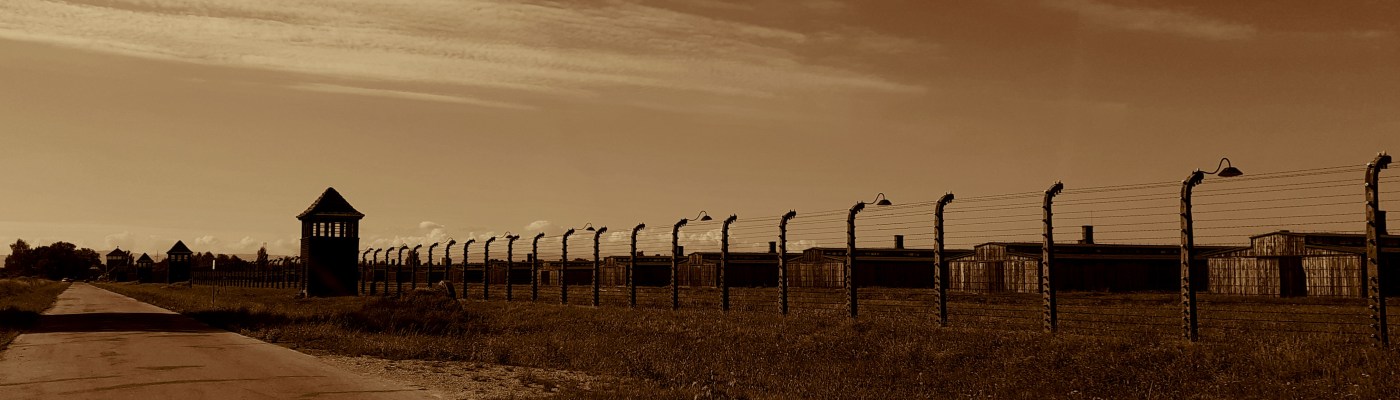
SS-Oberscharführer Alfred Ittner, one of the defendants in the trial against the officers of the Sobibór death camp –– a notorious camp in the eastern part of occupied Poland –– testified before a German court in 1965 and characterized the functioning of Sobibór as follows:
„The camp was a large and self-contained organization which had as its mission to kill as many Jews as quickly as possible … The mass murder of the Jews was not carried out by one single individual, but by a multitude of SS people. Each one was a small cog in the wheel driving an extermination machine that could work only as long as all of them did. That is why, in my opinion, all the camp guards at Sobibór, regardless of their actual job, carried out the killings of the Jews. I would like to emphasize particularly that on arrival of a transport all other work was abandoned, and the camp staff all took part in the actual extermination process.”
Ittner knew what he was talking about because he’d participated in the mass genocide at several different stages. He started with the camp accounting –– the collection of money and valuables from Jews being led to their death –– lying that it was a deposit for the time used for bathing. He then supervised labor prisoners ripping gold teeth from the dead and transporting corpses to mass graves. According to the testimonies of actual prisoners, he participated in the shootings of Jews who were too sick or exhausted to actually reach the gas chambers.
However, the German court didn’t listen –– and therefore failed to hear –– what Ittner had actually shared about the functioning and responsibility for the murders at Sobibór. Perhaps even worse… It may have been intentional. Because the court simply fundamentally disagreed with what Ittner had said.
According to German post-war law, mere presence in the camp and even active participation in the murder process were by no means sufficient grounds for finding the accused guilty. Therefore, by those standards the court initially discontinued the proceedings against Ittner, and only after a prosecutor’s appeal, sentenced him to just four years in prison. Shockingly, Ittner was convicted of „participating in the murder of approximately 68,000 Jews.” That deplorable punishment ultimately meant that slightly less than thirty-one minutes in prison was the actual penalty for „participating” in the murder of one innocent man.
In another similar case another murderer, SS-Scharführer Erich Fuchs, was found guilty of „participating in the murder of at least 79,000 Jews” and again sentenced to only four years in prison. During his trial, the accused Fuchs openly testified:
„We put the engine on a concrete plinth and attached a pipe to the exhaust outlet. Then we tried out the engine. At first it did not work. I repaired the ignition and the valve and suddenly the engine started. The chemist whom I already knew from Bełżec went into the gas chamber with a measuring device in order to measure the gas concentration. After this a test gassing was carried out. I seem to remember that thirty to forty women were gassed in a gas chamber. The Jewesses had to undress in a clearing in the wood which had been roofed over, near the gas chamber. They were herded into the gas chamber by the above-mentioned SS members and Ukrainian volunteers. When the women had been shut up in the gas chamber I attended to the engine together with Bauer. The engine immediately started ticking over. We both stood next to the engine and switched it up to „release exhaust to chamber” so that the gasses were channeled into the chamber. On the instigation of the chemist I revved up the engine, which meant that no extra gas had to be added later. After about ten minutes the thirty to forty women were dead.”
Is starting an engine and knowingly directing the gas into a gas chamber designed to kill people –– expecting that women in that chamber will die –– merely „participating in murder” and not simply the act of murder? As you can see, the German court perceived and actively applied that distinction. Those courts and the entire German justice system at that time –– through the 1950s and 1960s –– willingly pursued the principle that any officer carrying out his superiors’ orders was by definition merely a participant in the murder, never the perpetrator of that murder. Even if the action he performed directly determined the death of the victim.
Therefore, all those accused of carrying out activities leading to the deaths of hundreds of thousands of innocent human beings were acquitted or received grossly and inordinately short sentences. Only those who “exceeded the requirements of their superiors” and murdered on their own initiative were convicted of standard murder.
To be absolutely clear, what that definition of murder actually meant was that the SS officer who forced thousands of people into a gas chamber with a gun in his hand was not a murderer per se. Only when that officer voluntarily selected a single person from the crowd and killed them with a shot to the head or a lethal beating did he meet the actual definition of first-degree murder.
The legal logic was to punish those with malicious intention, and to avoid or minimize prosecuting those merely following orders. (Even though it was precisely those hands that caused the murder.) This approach guaranteed the murderers impunity or provided very lenient sentences.
That legal perspective only (and finally) changed after many decades. The breakthrough was the trial of John Demjanjuk, who wasn’t actually German, but a Ukrainian guard in a camp. In 2011, he was found guilty of murder, despite the fact that he’d never been proven to have committed any specific crimes. For the first time, mere participation in the machine of mass murder was enough to convict. And it happened just sixty-six years after the war, when almost all criminals had managed to die and therefore avoid punishment. This was hardly a coincidence.
According to German law over the course of those arduous and dismissive sixty-six years, only Hitler, Himmler, Goering, and Heydrich were “held responsible” for murdering innocent people. All the rest –– every last voluntary murderer of Jews and other civilian populations –– were merely “participants” carrying out the superiors’ orders. The intentional adoption of such a legal perspective allowed the German courts to protect the Nazis from the actual settlement of their war crimes.
And yes, the German lawyers actually followed German law. Quite stringently. They had nothing to reproach themselves for. This was confirmed by the judgment of the Federal Court of Justice in 1969. It ruled that in order to achieve a conviction, each accused perpetrator must be proven to have committed a specific crime. Confirmed by eyewitness testimony.
So legally speaking, the ashes of millions of victims were not sufficient evidence for the German courts.
The second principle the courts applied to those accused of Nazi war crimes was the assumption that officers’ “actions” had occurred in “life-threatening situations.” In other words, the courts recognized and emphasized the practical reality that if an officer shirked their duty to participate in a crime, they could be punished for it. In addition, the threat of punishment never had to be actual or even real; it was enough for the accused to claim that they subjectively believed it to be real.
Two facts in particular show how wrong this approach proved to be. The first is the utter lack of evidence that officers who asked to be transferred from death camps to another service were ever punished. On the contrary, when one of the Sobibór officers, SS-Unterscharführer Johann Klier, applied for immediate release, he was transferred without question or harassment. Secondly, the SS men weren’t administering Sobibór mass genocide under force or because of intimidation, but in most cases because they’d already proven their “murderous zealotry” against the German mentally ill, the government-sanctioned action code-named Aktion T4. More often than not, they’d actually volunteered to participate in this project.
Roughly twenty years after the end of World War II, the trials of Sobibór death camp officers began in the Federal Republic of Germany. No one ever denied that all the accused participated in the genocide. Twelve people stood trial, whose actions led to the painful, horrific, and unimaginable gas chamber deaths of 250,000 men, women, and children. Deaths defined by prolonged agony, especially when the engine that produced deadly exhaust fumes broke down. In those unforgivable cases, instead of dying over the course of thirty minutes, innocent human beings suffered for up to three hours before they finally died.
Beyond the description of German legal vernacular or the actual laws applied, the final verdict of the German court speaks volumes: five officers were acquitted, another five received ridiculously short prison sentences, and one committed suicide during the trial.
The only defendant sentenced to life imprisonment was Karl Frenzel, his conviction decisively influenced by the testimonies of witnesses which proved that he voluntarily exceeded his official duties –– ironically, the mass murder of people. He was not convicted for ensuring that an uninterrupted stream of men, women, and children flowed unhindered into gas chambers, but for a sadistic, manipulative murder described during the trial by one of the prosecution witnesses:
„A debilitated Jewish worker asked Frenzel to kill him because he could no longer bear living. Frenzel replied in a friendly tone that the man would not only not die but live, and in the future receive proper food. Frenzel was true to his word, inducing the camp cook to provide the desperate man with additional rations. After two weeks, Frenzel asked him whether he still wanted to die. The Jewish worker thanked him and said he was happy to be able to continue living. Frenzel drew his pistol with the words, ‘Now you wish to live, but now you must die,’ and shot him.”
Frenzel was charged with “personally killing 42 Jews and participating in the murder of approximately 250,000 Jews,” but was only found guilty of lesser crimes –– and a noticeably reduced statistic still in the hundreds of thousands –– namely “personally killing 6 Jews and participating in the mass murder of approximately 150,000 Jews.” Furthermore, it must be noted that he served only sixteen years of a life sentence and spent the last fourteen years of his life a free man.
The German state gained the legitimate right to hold its citizens accountable for their activities during World War II in 1949 with the founding of the Federal Republic of Germany. This created endless opportunities for the highly sophisticated, and clearly intentional and ill-willed, manipulation of the law to protect Nazi criminals from accountability. Until 1949, the trials against Third Reich officers accused of committing crimes were the sole responsibility of the military courts of the USA, USSR, Great Britain, and France. (Much less often German courts were subordinated to strict adherence to Allied authorities.)
First of all, it was impossible to sentence any war criminal to the death penalty because the Constitution of the Federal Republic of Germany abolished the death penalty in May 1949. Despite the constitutional declaration, the war criminals convicted by the International Military Tribunal in Nuremberg and the US Military Tribunal in Dachau continued to be executed on the territory of the German state. However, those justified and legitimate executions sparked strong protests from the German government, and in light of the subsequent treatment of the criminals by the German authorities, it should be considered a significant revelation of new post-war Germany’s distinct attitude and approach to German war crimes.
The last executions in Germany took place on June 7th, 1951. The death sentences were carried out against those convicted in the Einsatzgruppen trial –– professional units of murderers ordered to focus on civilians –– who in the postmodern Germany legal system would not only avoid death, but probably even long-term imprisonment.
After the war, the Federal Republic of Germany had a colossal problem. The majority of German society was organizationally linked to Nazi power, administrative distinction, and rabid ideology. About 8 million Germans –– or 10% of the population –– were members of Hitler’s party. Over 45 million Germans were affiliated with Nazi organizations (i.e. the German Labor Front, National Socialist People’s Welfare, League of German Women, Hitler Youth, et al.) that continually carried out intensive activities directly involving and propagandizing participants.
Especially in the quintessential and indispensable aspects of social life, it was simply impossible to replace people closely associated with Nazism with those free of Nazi ties. Therefore, it shouldn’t be surprising that as Michael S. Bryant writes in “Eyewitness to Genocide: The Operation Reinhard Death Camp Trials,” in 1953 72% of the judges sitting on the West German Supreme Court were active in Nazi-linked courts, and this number increased to 79% in 1956, and then fell –– only as a result of the retirement of judges –– to a full 70 percent by 1964.
Four years after World War II ended, 81% of judges and prosecutors in Bavaria –– or 752 out of 924 legal representatives –– were former members of the Nazi party. In May 1951, a law came into force guaranteeing civil servants dismissed for active Nazi certifications the right to return to state service. Although it wasn’t designed for former Gestapo, SD (Security Service) and SS officers, the law did outline the legal requirement that a minimum of 20% of all government departments and services should be held by former Nazis.
Historians infer that this increased the large-scale, seemingly wholesale former Nazi return to the German judiciary system. With laws enacted so actively and aggressively, it’s no wonder that most former Nazis removed from the judiciary immediately after the war –– roughly 90% even among conservative estimates –– returned to the profession over the next decade.
How did former prisoners of the Sobibór death camp react to the foundational attitudes of the German judiciary? Here are the words of Philip Bialowitz, author of “A Promise at Sobibór,” a Jewish boy’s story of revolt and survival in Nazi-occupied Poland:
„The punishments given to Wolf, Ittner, Dubois, and Fuchs could have been more severe. And the freedom that Gomerski enjoyed in his later years will always upset me. Being allowed to serve anything less than life in prison after murdering hundreds of thousands of innocent men, women, and children was more than an injustice — it was a betrayal of the victims and a dangerous signal to future murderers that they can get off lightly for the most serious crimes imaginable.”
The case of Hubert Gomerski, as mentioned by Bialowitz, deserves additional attention and emphasis because it’s another condemning example of how the legal system functioned in Germany. Gomerski was one of the cruelest SS officers in Sobibór. He personally murdered countless prisoners, contemptuously mistreated them, participated in active prisoner selections on the railway ramp, and specifically murdered children with pleasure.
In 1950 he was sentenced to life imprisonment for his murders committed at Sobibór and was imprisoned. However, the sentence was ultimately reduced to 15 years on appeal, after which Gomerski was let out of prison due to his failing health. New court proceedings resumed in 1981, but ended three years later in 1984, as Gomerski was found unfit to stand trial. Ultimately, he lived the next fifteen years in freedom, dying in 1999 at the age of 88, an indication that perhaps he wasn’t seriously ill after all.
Former Nazi prosecutors and post-war German judges did as much as possible –– if not objectively everything they could –– to protect Nazi murderers. At the same time, the German authorities refused to extradite the criminals to the countries where they had committed their crimes. It must be strongly emphasized that German lawyers, more than 90% of whom belonged to the NSDAP, effectively excluded themselves for their implicit “accountability” for their close, active, and servile cooperation with Nazism in the years 1933 to 1945.
Suffice it to say that German courts between 1933 and 1945 legally executed over 80,000 death sentences and stood by the Nuremberg Laws and explicitly sanctioned and “legalized” the Night of the Long Knives and other crimes committed by the Nazis. To a very large extent, the very same people who sentenced thousands of innocent people to death by committing de facto judicial murders during the Nazi era are the same co-conspirators who declared innocent thousands of Nazi murderers after the war.
The final conclusion is obvious and clear. It’s also gruesome and unforgivable: the German justice system was not only an accomplice of Nazism, but permanently contaminated the modern German state, the Federal Republic of Germany.
Germany’s refusal to apply legitimate law and punishment in its post-war legal system –– its commitment to protecting and preserving arguably the worst mass murderers in modern history –– is the original sin of injustice that should never be forgiven or forgotten.
Paweł Jędrzejewski
 Forum Żydów Polskich